
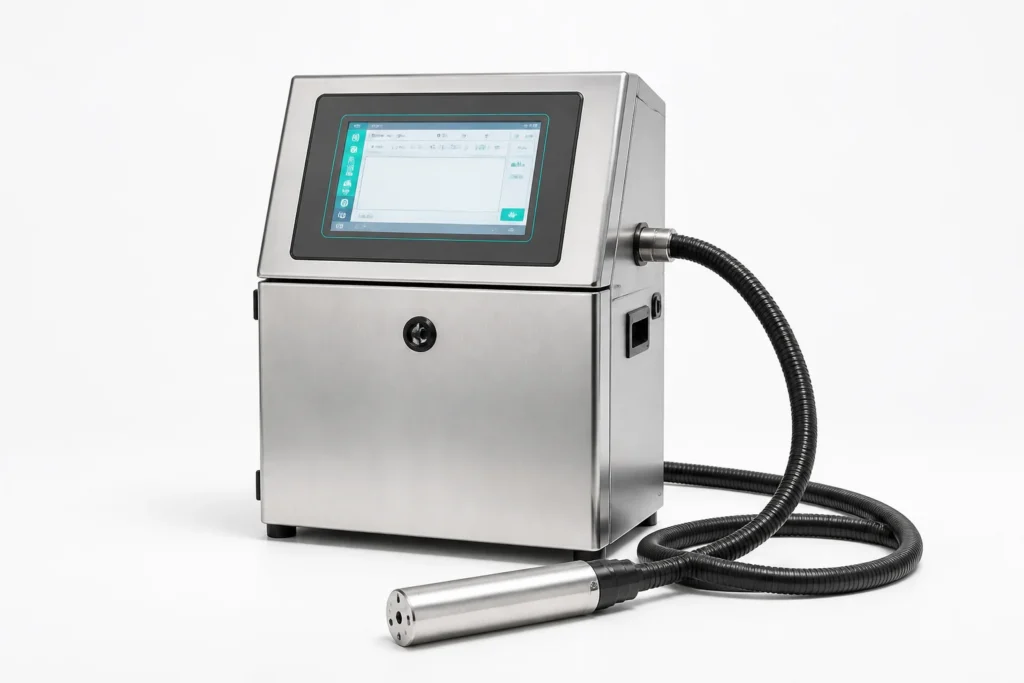
Selecting an industrial coding system is not only a question of print quality. The right choice must match the product surface, line speed, code content, operating environment, integration method, and total cost of ownership.
This practical guide compares four common technologies used by Malaysian manufacturers: continuous inkjet (CIJ), thermal inkjet (TIJ), laser marking, and thermal transfer label printing. It is a starting point for application review; final suitability should always be confirmed with representative samples and production-line testing.
Quick comparison of industrial coding technologies
| Technology | Typical strengths | Common applications | Points to confirm |
|---|---|---|---|
| Continuous inkjet (CIJ) | Fast, non-contact printing on moving products and varied shapes | Date codes, batch numbers, lot codes and traceability information | Ink compatibility, drying time, ventilation, cleaning and planned maintenance |
| Thermal inkjet (TIJ) | Compact design and high-resolution text, barcodes, QR codes and logos | Cartons, labels and suitable flat or controlled packaging surfaces | Substrate porosity, cartridge selection, print distance and line stability |
| Laser marking | Permanent marks without routine ink consumables | Traceability codes and durable marking on compatible materials | Material reaction, laser type, extraction, guarding and capital cost |
| Thermal transfer label printing | Sharp barcodes and variable data on labels | Product, inventory, shipping, pharmaceutical and logistics labels | Label material, ribbon grade, printhead resolution, width and durability |
When continuous inkjet is a strong fit
Continuous inkjet printers are commonly considered for fast production lines where the code must be applied without contacting the product. They can suit bottles, cans, cables, containers and other moving items when the correct ink, print distance and installation arrangement are selected.
CIJ is particularly useful for frequently changing date, batch, lot or serial information. During evaluation, confirm the substrate, required contrast, available drying time, production speed, ambient conditions and cleaning routine. Ink and solvent use, operator training and preventive maintenance should be included in the lifecycle cost.
When thermal inkjet is a strong fit
Thermal inkjet printers are compact systems that can produce high-resolution text, graphics, barcodes and QR codes. They are often considered where print clarity, straightforward cartridge changes and a small installation footprint are priorities.
The substrate is critical. Porous and non-porous materials can require different ink formulations, and the printhead must remain within the permitted distance from a stable surface. Check line vibration, product presentation, code width, print frequency and cartridge yield before comparing operating cost.
When laser marking is a strong fit
Laser marking systems create permanent marks on suitable materials and do not require routine ink consumables. They may be attractive for high-volume production, tamper-resistant traceability, or applications where code permanence is essential.
A successful laser application depends on how the material reacts to the selected wavelength and power. Sample testing is essential. The review must also cover extraction, guarding, interlocks, line speed, mark size, contrast, available installation space and operator safety requirements.
When thermal transfer label printing is a strong fit
Thermal transfer printers are a practical option when variable information is printed on a label before application. They support clear barcodes, text and graphics for product identification, logistics and inventory workflows.
Reliable output depends on matching the label material with the correct thermal transfer ribbon. Confirm printer resolution, label and ribbon dimensions, winding direction, print speed, handling conditions and the required resistance to abrasion, heat, moisture or chemicals.
Seven questions to answer before requesting a quotation
- What material will be marked? Provide the exact substrate, colour, finish, shape and representative samples.
- What information must be printed? Define the number of lines, character height, barcode type, QR code, logo and variable-data source.
- How fast does the line run? Record line speed, product spacing, available print window and daily operating hours.
- How durable must the code be? Consider handling, rubbing, moisture, heat, chemicals, outdoor exposure and expected product life.
- What is the operating environment? Note dust, humidity, washdown, temperature, vibration and any hazardous-area requirements.
- How will the system integrate? Identify conveyors, sensors, encoders, reject systems, PLC signals, databases and available installation space.
- What is the real lifecycle cost? Compare equipment, consumables, replacement parts, planned service, downtime risk and operator time—not purchase price alone.
A simple technology shortlisting guide
- For fast, non-contact date and batch coding on products of varied shapes, start by evaluating CIJ.
- For compact, high-resolution coding on a stable and compatible surface, evaluate TIJ.
- For a permanent mark on a material that responds well to laser energy, evaluate laser marking.
- For barcodes and variable data applied as labels, evaluate thermal transfer label printing.
More than one technology may meet the basic requirement. Sample tests and a site review reveal differences in readability, adhesion, integration effort, maintenance and long-term cost.
Plan for service and production continuity
Printer selection should include access to consumables, replacement parts, technical support and operator training. A documented cleaning and inspection routine helps protect print quality and reduce avoidable downtime. Review NEST CODING’s printer service and maintenance support when planning the complete installation.
Prepare for an application review
Send a product sample, current code image, substrate description, line-speed information and photos or video of the proposed installation area. NEST CODING can then narrow the technology options and recommend the next practical test.
Discuss your application
Need a product test, site visit, or technical review?
Share the material, code, speed, existing equipment, and current issue with the NEST CODING team.
Contact Our Team